
Understanding the National Geographic Rock Tumbler and Its Educational Purpose
The National Geographic Rock Tumbler is designed as an entry-level rock polishing system that introduces users to the fascinating world of geology, mineral formation, and lapidary craftsmanship. It is commonly recognized as a STEM educational tool that helps children, students, and hobby enthusiasts understand how rough natural stones can be transformed into polished gemstones through a controlled mechanical process. The product is widely associated with hands-on science learning because it combines geology with patience, observation, and experimentation.
At its core, this rock tumbler is a rotary machine that simulates natural erosion processes. In nature, rocks become smooth over thousands of years due to water flow, friction, and environmental pressure. The National Geographic Rock Tumbler compresses this process into weeks, allowing users to observe gradual changes in texture and appearance. This makes it a valuable educational resource for developing curiosity about Earth science and mineral structures in a practical, engaging way.
How the Rock Tumbling Process Works Step by Step
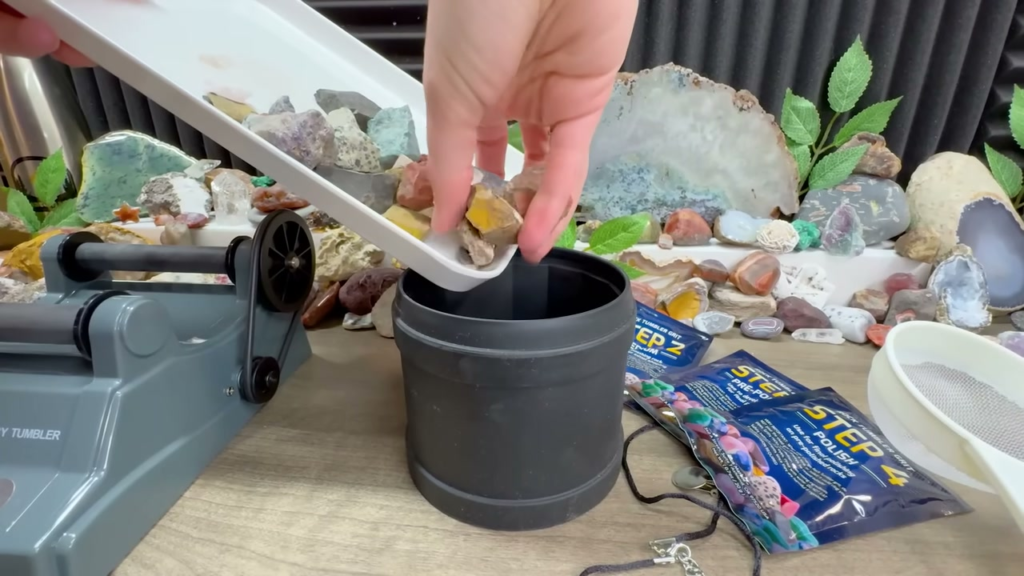
The rock tumbling process used in the National Geographic Rock Tumbler follows a structured mechanical polishing cycle. It begins with rough stones placed inside a rotating barrel along with coarse rock tumbling grit. As the barrel spins continuously, the friction between stones and abrasive particles gradually chips away sharp edges and rough surfaces. This stage is essential for shaping the stones before finer polishing begins.
As the process continues over several cycles, the grit is replaced with progressively finer polishing compounds. Each stage refines the surface further until the rocks become smooth and glossy. This gradual refinement mimics natural geological weathering but in a controlled environment. The entire process typically takes several weeks, depending on rock hardness, grit quality, and tumbling consistency. Many users find that patience is a key part of achieving successful gemstone polishing results.
Features and Design of the National Geographic Rock Tumbler Kit
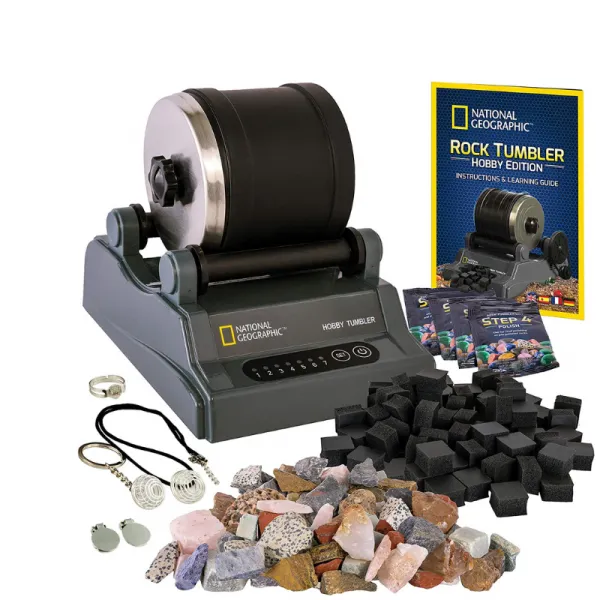
The National Geographic Rock Tumbler is commonly sold as a complete rock tumbling kit that includes everything a beginner needs to start immediately. Most versions come with a durable rotating barrel, a motorized base, polishing grit, rough gemstones, and instructional material. This all-in-one setup is especially helpful for beginners who are unfamiliar with lapidary tools or mineral processing techniques.
The design focuses on simplicity and educational accessibility. The barrel is engineered to reduce leaks and improve rotation stability, while the motor is designed for long-duration operation since rock tumbling requires continuous motion for days at a time. Many updated models also include noise reduction improvements, although the machine still produces a steady mechanical sound during operation. This makes placement important, often in a garage or utility area rather than a quiet room.
Educational and STEM Learning Value for Students and Families
One of the most important aspects of the National Geographic Rock Tumbler is its strong educational value. It is widely used as a STEM learning kit in homes and classrooms to teach geological processes in a tangible way. Students can directly observe how physical forces shape natural materials over time, which strengthens their understanding of Earth science concepts such as erosion, mineral hardness, and sedimentary transformation.
Beyond geology, the tumbler also teaches patience, consistency, and scientific observation. Since the process takes several weeks, users learn to track progress and understand that meaningful results often require time and repetition. Parents and educators often appreciate this aspect because it encourages focus and long-term engagement, especially in children who are developing early scientific thinking skills.
Types of Rocks and Materials Used in Tumbling
The success of a rock tumbling project depends heavily on the type of stones used. The National Geographic Rock Tumbler typically includes a starter mix of rough gemstones such as quartz, agate, and jasper. These minerals are ideal because they are hard enough to withstand tumbling without breaking apart, yet responsive enough to polish into smooth, shiny surfaces.
In addition to included stones, many hobbyists eventually expand their collection by gathering natural rocks or purchasing additional mineral packs. The quality and uniformity of stones play a major role in final results. Hardness consistency is especially important because mixing soft and hard stones can lead to uneven polishing outcomes. Over time, users develop a better understanding of mineral selection, which is a key part of the lapidary hobby.
Role of Rock Polishing Grit in the Tumbling Process
Rock polishing grit is one of the most critical components in the tumbling process. It acts as the abrasive agent that gradually wears down rough surfaces. The National Geographic Rock Tumbler kit typically includes multiple grades of silicon carbide or aluminum oxide grit, each designed for a specific stage of polishing. Coarse grit begins the shaping process, while finer grades create smooth and reflective surfaces.
Each stage of grit must be used in sequence to achieve proper results. If the process is rushed or steps are skipped, the stones may not achieve a polished finish. This structured layering of abrasives reflects real lapidary techniques used by professionals, making the kit not just a toy but a simplified version of industrial gemstone polishing methods. Proper cleaning between stages is also essential to prevent contamination of finer grit with coarse particles.
Performance, Motor Quality, and Long-Term Reliability
The National Geographic Rock Tumbler is generally considered reliable for beginner and intermediate use. Its motor is designed to run continuously for extended periods, which is necessary for rock tumbling cycles that can last up to a week per stage. This continuous operation is a key requirement in rotary tumbler systems and reflects how the device is engineered for educational durability rather than industrial-scale production.
While the motor performance is stable for most household applications, users should understand that it is not a professional-grade lapidary machine. Extended heavy use may lead to wear over time, particularly in the barrel or internal drive components. However, for its intended purpose as a beginner rock polishing kit, it provides consistent and satisfactory performance when used according to instructions.
Common User Experiences and Practical Challenges
Many users report positive learning experiences with the National Geographic Rock Tumbler, especially when it comes to understanding geology and mineral transformation. However, like most beginner-level lapidary tools, it does come with some challenges. One common issue is the time required for full polishing cycles, which can feel slow for first-time users expecting quick results.
Another challenge involves managing expectations about final shine quality. While many stones polish beautifully, results can vary depending on rock type and grit consistency. Some users also find that the machine produces noticeable vibration and sound during operation. Despite these minor drawbacks, most users still consider it a rewarding educational tool because it provides a real-world introduction to gemstone polishing and mineral science.
Tips for Achieving Better Rock Tumbling Results
Achieving high-quality polished stones with the National Geographic Rock Tumbler requires careful attention to process consistency. Ensuring that each tumbling stage is completed fully before moving to the next is one of the most important factors. Proper cleaning of stones and barrel between stages also helps prevent scratches caused by leftover coarse grit particles.
Selecting suitable rocks also improves outcomes significantly. Hard, uniform minerals such as agate and quartz tend to produce the best results because they respond well to abrasion and polishing. Over time, users develop a better understanding of how different minerals behave, which enhances both results and overall enjoyment of the lapidary hobby.
Why the National Geographic Rock Tumbler Remains Popular
The continued popularity of the National Geographic Rock Tumbler comes from its balance of education, accessibility, and hands-on engagement. It allows users to experience geological transformation in a way that textbooks cannot fully replicate. This combination of learning and creativity makes it appealing to families, schools, and science enthusiasts.
Despite the availability of more advanced rock tumblers in the market, this model remains a preferred choice for beginners due to its simplicity and all-in-one design. It successfully introduces users to the broader world of geology, mineral polishing, and earth science exploration, making it a foundational tool for anyone interested in starting a lapidary journey.
Conclusion
The National Geographic Rock Tumbler stands out as a practical and educational entry point into the world of geology and rock polishing. It takes a natural scientific process that normally occurs over thousands of years and brings it into a controlled, hands-on learning experience that users can observe at home. This transformation from rough stones to polished gemstones helps bridge curiosity with real scientific understanding, making it especially valuable for beginners and students.
While it is not a professional-grade lapidary machine, it delivers consistent results when used correctly and patiently. The true strength of this tumbler lies in its ability to teach discipline, observation, and the fundamentals of Earth science through experience rather than theory. For anyone interested in starting a simple yet meaningful geology hobby, the National Geographic Rock Tumbler remains a reliable and rewarding choice.